

 Menu
Menu
If you are going for Chocolate, think Dark. The cocoa bean in chocolate has tannins,…



Is chocolate good for you?
11th July 2019 by James Goolnik

Chocolate is one of the most celebrated foods that everyone yearns for.
Western cultures now have whole holidays that revolve around it, Easter and Christmas without a good chocolate binge just wouldn’t be the same. Chocolate was first discovered over 4000 years ago by the Mayan and Aztecs in South America, where it was used as a form of currency and consumed as a bitter spiced tonic that was said to have medicinal qualities. Nowadays, chocolate comes a huge variety of forms, cleverly branded and always in arms reach at any shop or cafe for that impulse buy when you need that sugar hit.
| Calories (Kcal/100g) | Fat (g/100g) | Sugar (g/100g) | |
| Dairy Milk | 534 | 30 | 56 |
| Galaxy | 545 | 32 | 55 |
| Snickers | 491 | 24 | 50 |
| KitKat | 518 | 26 | 49 |
| Mars | 448 | 16.7 | 59.9 |
The table above compares some of the most popular chocolate bars, its easy to note that around 50% of you chocolate bar is pure sugar and around one third is fat. The most common varieties in the UK (Dairy Milk, Galaxy, Mars) are filled with sugar. Consuming large quantities of chocolate can considerably increase an individual’s calorie intake and may lead to weight gain and obesity. In turn increase the risk of cardiovascular disorders, diabetes and dental decay.
Labels
Always check the nutrition label on the back and check for nutrients and in this case sugar content per 100g. Compare brands so you can choose the healthier version. Foods are considered high in sugar if they have more than 22.5g of total sugars per 100g and low in sugar if there is less than 5g of total sugars or less per percentage of cocoa (70%+) has much lower sugar content compared to milk and white chocolate varieties.
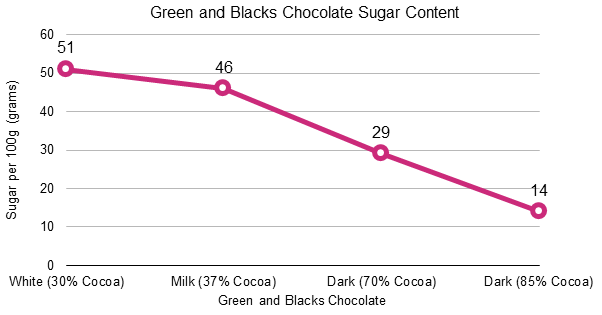
Not all chocolate is created equal.
The chart above shows how dark chocolate with a high percentage of cocoa (70%+) has much lower sugar content compared to milk and white chocolate varieties.
There are reported health benefits of dark chocolate which comes from flavonoids, a group of phytonutrients or plant chemicals. Flavonoids are produced by plants, fruits, and vegetables, and can be found in red wine and green and black tea. Flavonoids act as an antioxidant and anti-inflammatory.
Dark chocolate and cocoa are not the only foods that contain flavanols. Many fruits and vegetables are rich in flavanols, including apples, red grapes, broccoli, tomatoes, beans, kale, and onions. Perhaps it’s no coincidence that a healthy balanced diet is typically one that is high in fruits and vegetables and, as a result, high in flavanol content as well.
UK Top 10 Lowest Added Sugar Bars (Sugar per 100g)
| 1 | Paul.A.Young 100% Madagascan blend 0.0g |
| 2 | Montezuma’s Absolute Black 100% 0.5g |
| 3 | Vivani 99% cacao organic dark 0.5g |
| 4 | Willie’s Cacao Pure 100% Gold Sur del Lago Cacao 0.6g |
| 5 | Lindt Excellence 99% 1.0g |
| 6 | Paul.A.Young 91% Nocturne blend 5.0g |
| 7 | Lindt Excellence 90% Dark Supreme Chocolate Bar 7.0g |
| 8 | Vivani Organic 92% coconut blossom dark chocolate 7.0g |
| 9 | Waitrose Dominican Republic Dark Chocolate 90% 9.0g |
| 10 | Sainsbury’s 85% Cocoa Dark Chocolate, Taste the Difference 10.4g |
Still craving a chocolate hit?
So, if you are still craving that chocolate hit, steer clear of any of the candy bar varieties and be sure to choose a bar that contains at least a 70 percent cocoa content. This will ensure there are minimal added sugars and fats, so you get the bittersweet goodness without the damaging effects of high sugar consumption. Try Green & Blacks or Lindtt. You can also find a low sugar chocolate cake recipe in James’ Kick Sugar cookbook. Treat yourself a copy of the book here.
Healthier alternatives
As well as this, we must bear in mind that chocolate, in any form, is something that should be enjoyed on occasion, but not on every occasion. In order to incorporate chocolate into part of a healthy lifestyle, remember to keep it as a treat and have some healthy snack alternatives on hand for when you feel peckish. If you want healthy snack ideas, why not check out Rewards Project‘s low sugar snack recipes here.
Book in with a Bow Lane Dentist to check if your chocolate habit has damaged your teeth and find out more tips on teeth-friendly treats!
A big thank you to Stewart Beggs for writing this tasty blog.
Related Posts


Request your appointment today

"Amazing! Been coming here for years, never had anything but great experiences"
Taavi Davies
"This is a truly excellent and professional dental surgery - by far the best I've found"
Jo H
"Bow Lane have been looking after my teeth for ten years, I wouldn't go anywhere else"
Emily Burt
"Undeniably the best dentistry in the City. I've received fantastic service from here"
Helen Man
Related Posts
Get more news





Get in touch
| 020 7236 3600 |
| reception@bowlanedental.com |
Opening hours
| Monday | 07:45 - 17:30 |
| Tuesday | 07:45 - 17:30 |
| Wednesday | 08:30 - 17:30 |
| Thursday | 07:45 - 17:30 |
| Friday | 08:00 - 17:00 |